
August 2026 Update
Updated: 3 days ago
Twenty-eight people joined our August Bat (and Moth) trapping night, during which we trapped three bats (a male and female Natterers and a Whiskered bat). This was the first time a Whiskered bat had been recorded at Mount Wood; they are much more common in the north and west of the UK. They are a small, shaggy, dark grey bat.
One of the attendees was budding wildlife photographer Bella Fry, a 15-year-old student from the Gatwick School who has visited Aspect previously (see April blog for some of her excellent photos), and she captured this amazing photo of the Whiskered bat.

Back in April, we installed a ‘smart’ mink trap in the Mans Brook, which runs through Aspect Nature Reserve. The trap was supplied by the Waterlife Recovery Trust, which has successfully eliminated mink (an invasive species that predates on our native water voles) from East Anglia, and the Trust is now moving their attention to West Sussex.
The trap is ‘smart’ because it has a sensor that pings a message to my phone to say when it has been activated. The trap was installed in April, and for 16 weeks there was no sign of any activity.
And then, at 8 am on Aug 14th, my phone pinged with the trap activation message.
Unfortunately, I was already 2 hours into a drive to start my holiday. I weighed up the pros and cons of suggesting to my wife that we return home to check the trap and made the tactical decision to contact my lovely friend Paul and ask him to visit the trap instead.
This was not an easy task, but - hero that he is – he dutifully visited the site, recovered the trap, and humanely dispatched the mink.
The mink carcass was then stored in my freezer for subsequent analysis, with a DNA sample being sent to the Waterlife Recovery Trust. It was 55cm long, head to tail tip, and weighed 666g, which might seem big, but mink can get to over twice this weight.
Sexing the mink proved to be much harder than I had expected. The expert advice on how to do it was as follows:
To sex a mink, one needs to examine the distance between the anus and the genital opening on the underside of the base of the tail. Males have a greater distance between the anus and the penile sheath/opening (where a small bone, the baculum, can sometimes be felt), whereas females have their urinary/genital opening much closer to the anus’.
Fascinating though the above information is, it isn’t particularly useful unless you know what the distances should be. I had no frame of reference! However, I believe it was a female. See photo and decide for yourself!


My favourite woodland creature is the stoat (with the weasel coming a close second). One could argue that they are the UK equivalent of the American Mink, but are smaller, less aggressive, and native to the UK.
I have been trying to capture a decent video of a stoat/weasel for months, with my camera positioned at an area where I know there is lots of rodent activity (the preferred prey for stoats). I managed to capture this fleeting glimpse of a weasel. It is almost deliberately avoiding the camera!
The best videos, I think, are the ones where we have captured two or more species. Here is one from the pond at Mount Wood (which still has water!) with a Woodpecker and three Jays. They don’t appear to notice each other, at least not initially…
This year's drought has been particularly harsh, with our pond becoming completely empty.

Never one to miss an opportunity, we decided to grab the opportunity afforded by the empty-pond to build a pond dipping platform (for school pupils to use). This is a surprisingly complicated (and expensive) task, because of all the necessary health and safety concerns.


Finally, we were recently approached by Netflix/Guy Richie Productions to see if we would allow a short-term advert to be painted on our field that is directly under the Gatwick flight path. The advert was to publicise the forthcoming Netflix series ‘The Gentlemen 2’. (For those not familiar with The Gentlemen series, it is a black comedy with a complicated plot about a man who inherits his father stately home only to discover it is being used as a cannabis farm).
There were various designs proposed (one involving a 100m square cannabis leaf!), but the one finally selected made oblique reference to the summer drought and the fact that no one has been able to water their grass to make it green.
In the end, the field was painted green, which rather nicely makes the image stand out even more.
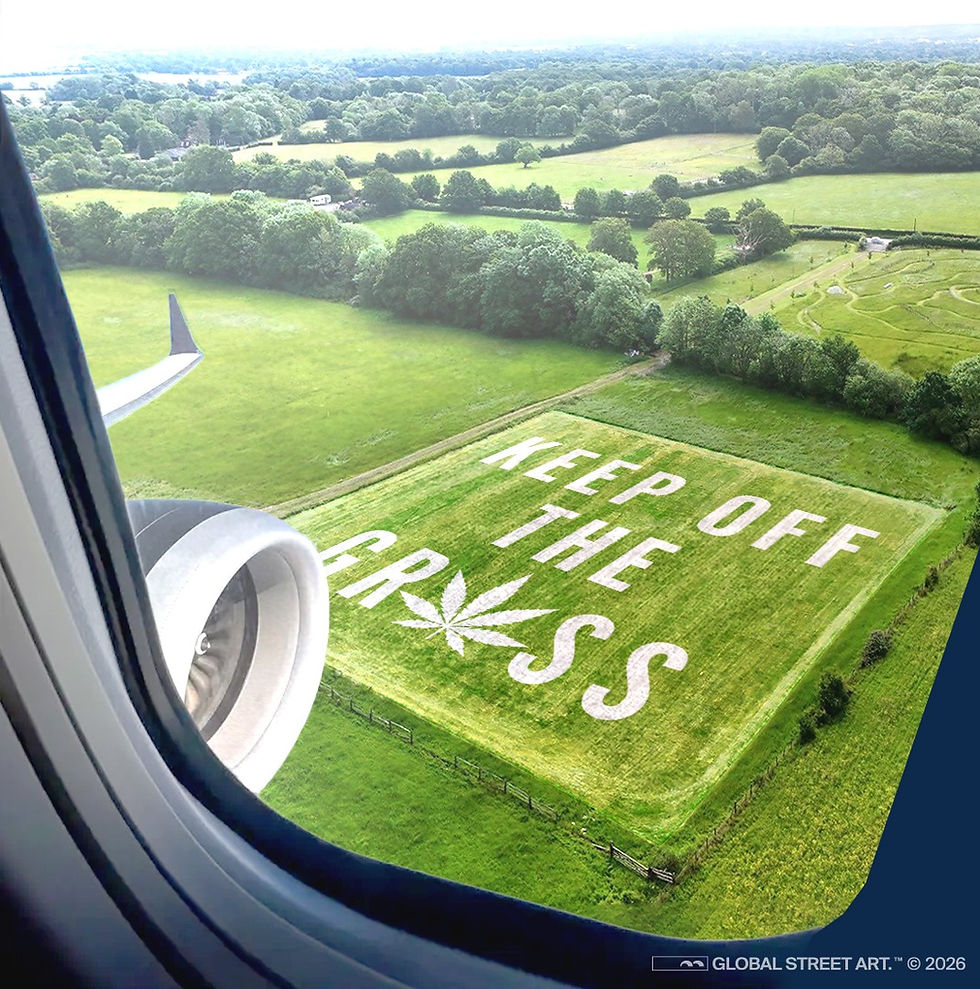
The fee Netflix paid for this advert will be used by our not-for-profit foundation (The Aspect Foundation) which provides support to local schools for education around ecology, biodiversity and climate change.
See you next month.


Threw together a baby shower word search about an hour before guests turned up. Typed twenty baby-related words, printed fifteen copies, done. Not clever, but it broke the ice.